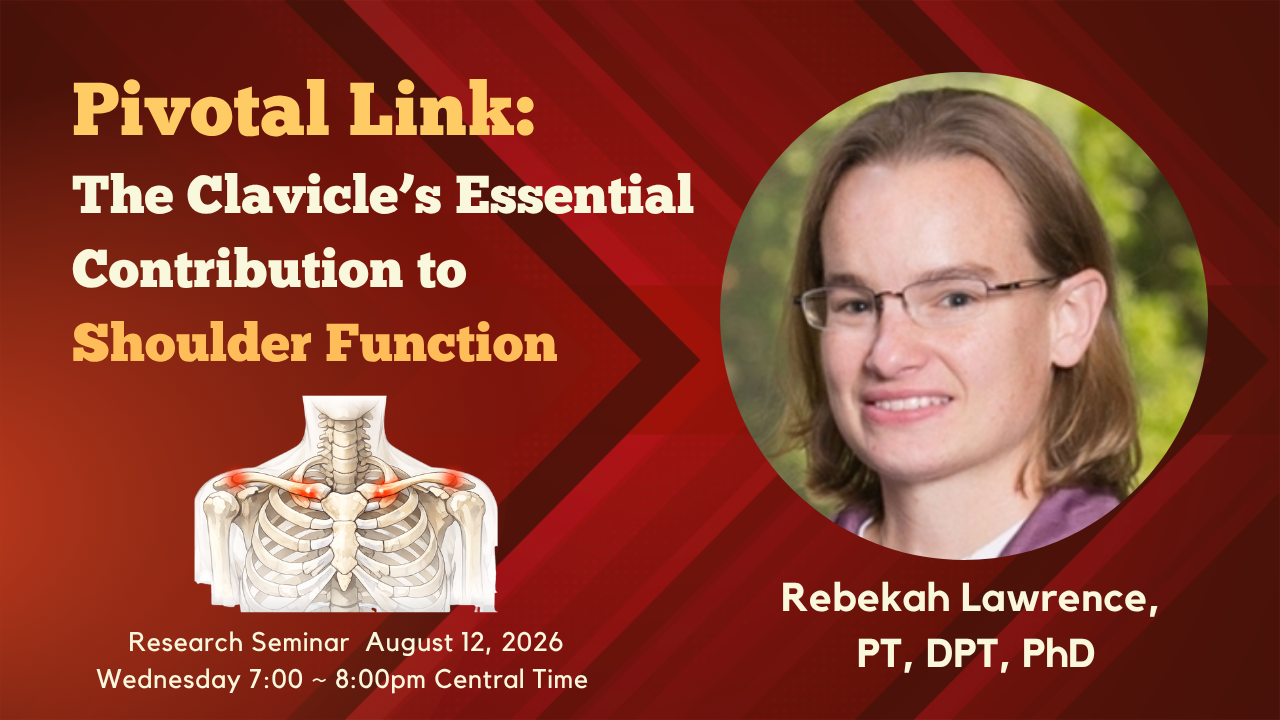
Pivotal Link: The Clavicle’s Essential Contribution to Shoulder Function
Rebekah Lawrence, PT, DPT, PhD
Webinar Description:
This continuing education session will provide an evidence-based review of the anatomy, biomechanics, and clinical relevance of the clavicle in shoulder function. Participants will review the clavicle’s anatomy and role in scapulothoracic motion, upper extremity load transfer, and shoulder stability. We will review new evidence regarding variability in clavicle shape and consider how it may impact clinical assessment of scapular motion. Finally, we’ll discuss how common clavicular pathology (e.g., fractures, AC/SC joint dysfunction) influences movement and function.
Learning Objectives:
Upon viewing this webinar content, and passing the post-webinar quiz on the course page, the participants will be able to:
- Define the motions of the sternoclavicular and acromioclavicular joints.
- Describe how the sternoclavicular and acromioclavicular joints contribute to scapulothoracic motion.
- Recognize variability in clavicle shape and hypothesize how it may impact shoulder function.
- Describe how common clavicular pathologies influences movement and function.
Rebekah Lawrence, PT, DPT, PhD
Dr. Rebekah Lawrence is an Assistant Professor in the Program in Physical Therapy and the Department of Orthopaedic Surgery at Washington University School of Medicine in St. Louis, where she leads the Shoulder Biomechanics and Rehabilitation Laboratory. She earned her Doctor of Physical Therapy from St. Ambrose University, completed an Orthopaedic Physical Therapy Residency and is a Board Certified Orthopaedic Clinical Specialist, and went on to earn her PhD in Rehabilitation Science from the University of Minnesota, followed by a postdoctoral fellowship at Henry Ford Health System. Dr. Lawrence's research focuses on the multifactorial etiology of rotator cuff pathology, scapulothoracic and glenohumeral kinematics, and the role of shoulder biomechanics in the development and progression of musculoskeletal conditions — work supported by funding from the National Institutes of Health. She has published extensively in leading journals including the Journal of Orthopaedic and Sports Physical Therapy, Journal of Biomechanics, and Physical Therapy, and has received numerous honors including the Early Career Investigator Award in Biomechanics Research from the APTA Academy of Research.
By registering for this course, you agree NOT to share your KAJABI / Learn Movement System log in, the Zoom links, or handouts with anyone else. You agree to only utilize the materials for personal learning.
For this webinar registration, you have 30-day recording access.