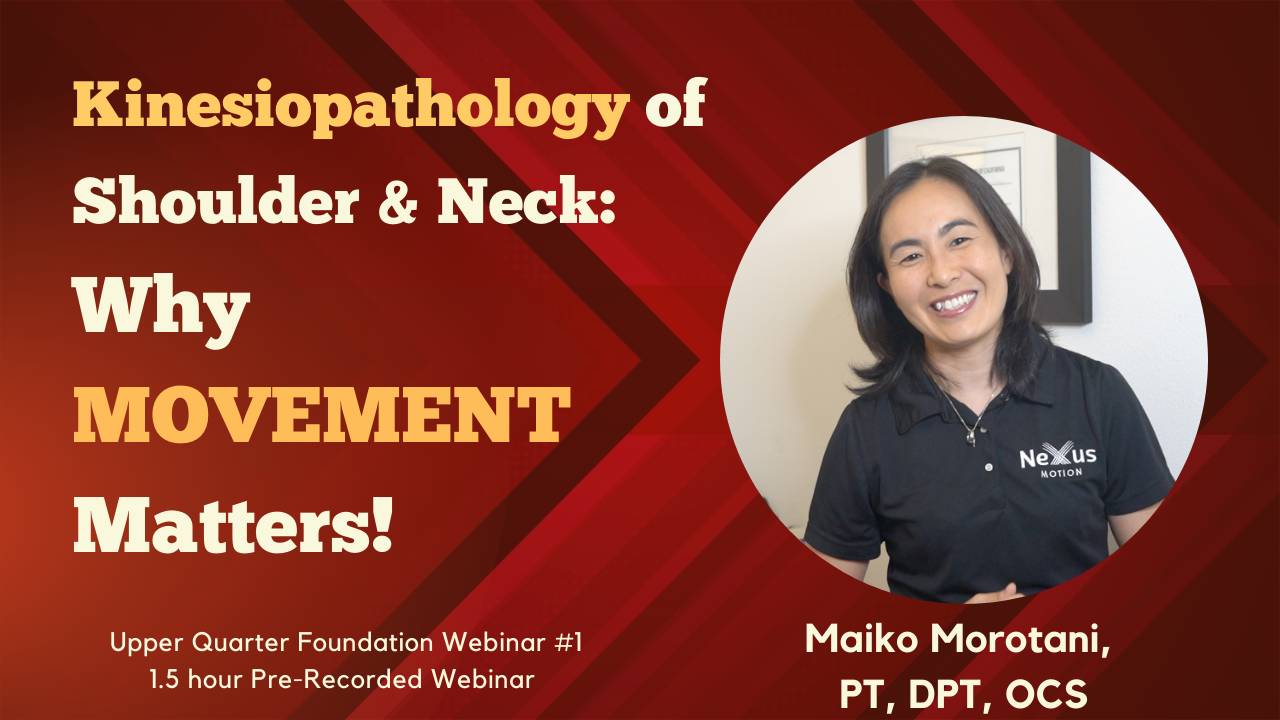
Kinesiopathology of Shoulder & Neck: Why MOVEMENT Matters!
This is the first of five Upper Quarter Foundation Webinars in 2026.
- Live event date: January 28, 2026 Wednesday, 7pm-8:30pm Central Time (Recording is now available)
- Speaker: Maiko Morotani, PT, DPT, board certified specialist in orthopaedic physical therapy
When you register for Foundation Webinars, you will be registered for all 5 Upper Quarter Foundation Webinars for $200. If you are currently an active ALL ACCESS member, you do not need to register, as these 5 webinars are included in your membership.
Find out why so many of Maiko's patients tell her, "I wish I met you years ago!" Coming to this webinar makes you remember why you studied anatomy & kinesiology in school.
Webinar Description
This webinar will describe the movement system and its theoretical construct: the kinesiopathological model. Physical therapy has its roots in the treatment of patients with movement dysfunction that results from disorders of the nervous system, the musculoskeletal system, and even the cardiopulmonary system. Traditionally these conditions were considered to have an acute onset and the physician diagnosed the condition. The kinesiopathologic model recognizes that most musculoskeletal dysfunctions are chronic and lifestyle-related. This model proposes that movement induces or exacerbates musculoskeletal dysfunction. Physical therapy can identify the cause and contributing factors rather than primarily treat the symptoms and consequences. This session will describe the movement system, the kinesiopathologic model and its general relationship to shoulder girdle pain conditions.
Learning Objectives
Upon viewing this webinar content, and passing the post-webinar quiz on the course page, the participants will be able to:
- Describe the components of the movement system.
- Discuss why the movement system is the identity of physical therapy.
- Explain the kinesiopathologic model and its key components.
- Describe how the model is related to basic shoulder movement impairments.
To receive CEU approved by California PT Association, participant must complete the course evaluation AND score 80% or higher on the post-webinar quiz. CEU will expire on January 28, 2027, therefore, post-webinar quiz must be passed before the recording access expires or by January 28, 2027, whichever comes first.
Schedule
Live event date: January 28, 2026 Wednesday (Central Time) (Recording is now available)
7pm ~ 7:05pm: Speaker introduction and announcements
7:05pm ~ 8:15pm: Lecture on Kinesiopathologic Principles
8:15pm ~ 8:30pm: Q&A and discussion
Speaker Profile
Dr. Maiko Morotani is from Osaka Japan. As an undergraduate student, she was so inspired by Dr. Susie Deusinger, then director of Program in Physical Therapy at Washington University in St. Louis. This fateful meeting lead her to pursue her DPT degree from WashU. It has been Maiko’s mission to continue learning about the movement system, and to share the knowledge with her Japanese physical therapy community. She is one of seven Japanese translators of the textbook Movement System Impairment Syndromes of the Extremities, Cervical and Thoracic Spines. Since 2014, she started Nexus Motion, a continuing education company primarily for Japanese physical therapists. Since 2022, Learn Movement System was created under Nexus Motion to serve English-speaking physical therapists. Under Maiko’s leadership, Movement System Syndromes content continues to evolve, as she collaborates with passionate educators, clinicians, and researchers. Maiko has taught movement system courses in the US, Japan, South Korea, and Thailand. She was a keynote speaker at the 2023 Asian Confederation of Physical Therapy Congress. As a board certified specialist in orthopedics, she has treated patients with neuromusculoskeletal dysfunctions in the Los Angeles area for over 20 years and currently provides mentoring service to clinicians.